Published on Thu, 17 Sep 2026 in NEWS
The long-standing summer school on semiconductor technology, the “Dresden Microelectronics Academy (DMA)”, was once again a success in 2026, featuring a packed five-day program from September 7 to 11.
For the 50 young participants, this 24th edition left a thoroughly positive impression—and provided a wealth of new knowledge, in-depth insights into local chip manufacturers, and fresh perspectives on potential career paths. The week-long summer school organized by cfaed (Center for Advancing Electronics Dresden) at TU Dresden brought together students, researchers, and industry experts to facilitate a deep dive into the world of microelectronics, semiconductor technologies, and innovations.
Read more … Dresden Microelectronics Academy (DMA) 2026 – Tradition in Transition
Published on Wed, 12 Aug 2026 in NEWS
The Chair of Network Dynamics (Prof. Marc Timme) is offering a Research Associate / Postdoc (m/f/x) position in the area of basic research on statistical physics and nonlinear dynamics of complex systems and networks.
The task will be:
Closing date: 31 August, 2026
Click here for more information.
Published on Tue, 30 Jun 2026 in NEWS
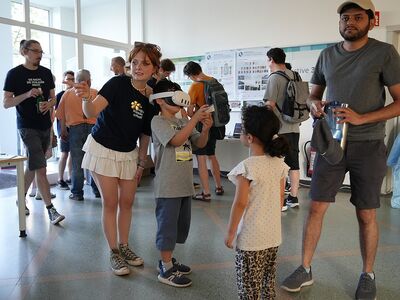
Das Thermometer zeigte 34°... die Wissenschaftsstadt Dresden hatte sich einen der wärmsten Abende ausgesucht, um wie jedes Jahr Tausende Neugierige zur Langen Nacht der Wissenschaften in die Hochschulen, Labore, Hörsäle, Archive, Sammlungen und Institute zu locken. Und - es hat funktioniert! Neugier gewann gegen Hitze-Lethargie. Vielleicht war der Run etwas kleiner als in Spitzenjahren, aber dadurch bot sich die Möglichkeit, an einigen Stationen länger zu verweilen, einen Frage mehr zu stellen, und dem Thema intensiver auf den Grund zu gehen.
So zeigte es sich auch an unseren Ständen, die wir mit dem ForLab Verbund, dem TRR404 Active-3D-Projekt und dem NaMLab aufgebaut hatten. Was da los war, das kann man hier noch mal nachlesen - oder einfach durch unsere Galerie klicken 😊 Danke an alle wissbegierigen jungen und älteren Besucher:innen, und danke an alle, die mitgeholfen haben, dass es ein tolles Erlebnis wurde!
Read more … Wissenstransfer bei 34° - das war die Lange Wissenschaftsnacht!
Published on Wed, 24 Jun 2026 in NEWS
cfaed is offering a Research Associate / PhD student (m/f/x) position in its Junior Research Group Single Molecule Machines (SMM, Dr. Francesca Moresco). The independent research group focuses on the physical properties of organic molecules, which are investigated using scanning probe microscopy. The group has extensive experience in molecular manipulation and on-surface synthesis for studying model systems for electronics and energy storage at the nanoscale. The topic of the position will be: On-Surface polymerization of N-heterocyclic carbene: From 1D to 2D and vertically switchable architectures
See more information and closing date.
Published on Wed, 17 Jun 2026 in NEWS
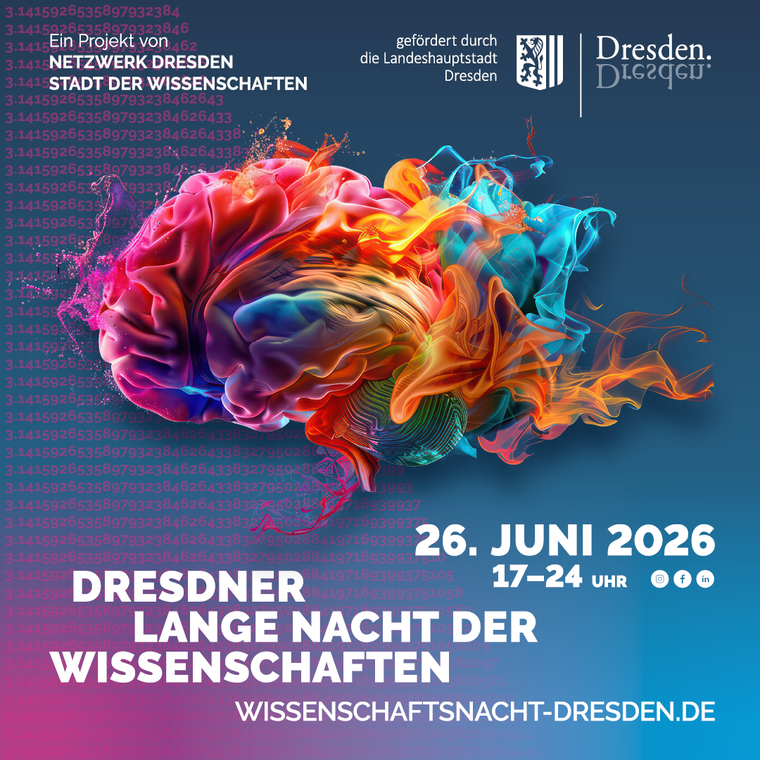
Eine Nacht voller Wissen! Unzählige Institute, Labore, Hörsäle, Archive und Sammlungen öffnen wieder für alle Wissbegierigen und Neugierigen. Das gesamte Progamm ist hier zu finden: www.wissenschaftsnacht-dresden.de
Da es unmöglich ist, das komplett durchzulesen, hier unsere Tipps aus dem Umfeld und Projekten des cfaed ;-)
Und hier sind alle Beiträge der TU Dresden zusammengefasst.
Read more … Lange Nacht der Wissenschaften bei cfaed / ForLab / TRR active3D
Page 1 of 109